David Nugent's Portfolio
I'm currently running Breaks & Ciphers, a small R&D lab focused on open-source cybersecurity, cryptography, and privacy. In this site, I'll take you through the story of my career so far.
If you don't have time to read, looking at the pictures should give you a good overview!
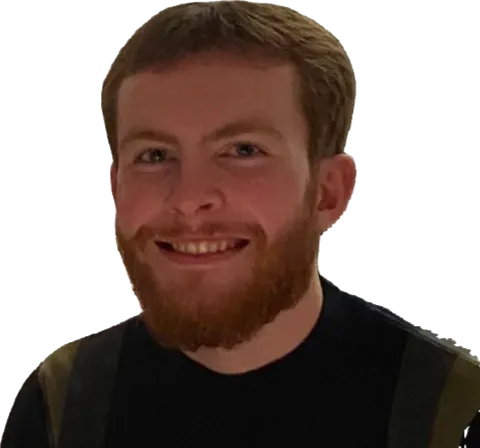
Chapter 1: Academic Achievements
To understand my career path and attributes, a good starting point is my education at secondary school level. I used the Irish equivalent of the SATs, the Leaving Certificate, as an opportunity to prove myself and gain confidence. I got the maximum number of points possible, 625, which means I scored over 90% in six varying subjects. Another confidence boost for me came unexpectedly, when I was one of three students in Ireland to get 100% in the Applied Mathematics exam.
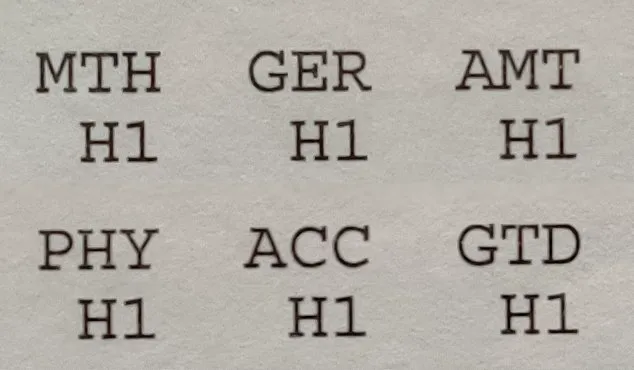
625 points, achieved by 0.3% of students in Ireland in 2018
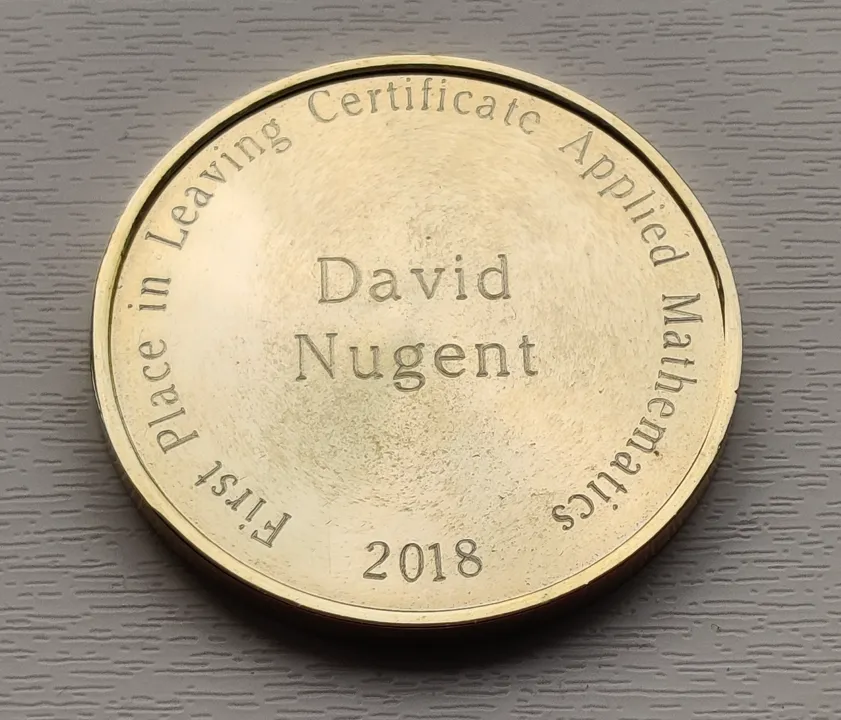
100% in Applied Mathematics, achieved by three students in Ireland in 2018
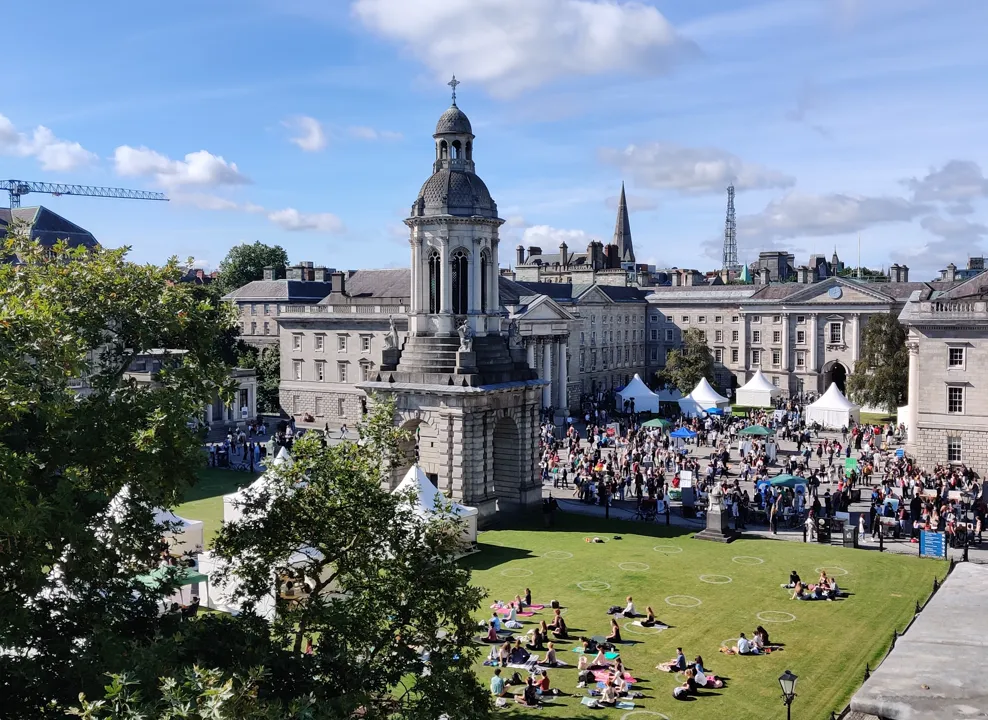
For university, I chose to study Computer Science, because I had tried out programming a few times before and felt that I had a natural talent for it. Being a Dubliner, Trinity College was my destination.
Trinity has a historic set of exams that students can sit in second year, named Schols, which give people the opportunity to gain a full five-year scholarship, along with accommodation and meals. I really wanted to move out, so I gave it everything I had. I managed to win the scholarship, placing first in Computer Science.
I placed 1st in Trinity College's Schols exams for Computer Science, which awarded me a full five-year scholarship including accommodation and meals
Chapter 2: Skills in practice
After I got Schols, I wanted to start prioritizing creation over examination. When the first covid lockdown happened, I kept myself occupied by doing some online courses in AI. I then made a mobile app named BarPath which uses AI to track the path that a barbell takes during weightlifting. The more straight the path, the more efficient the lift. This was my first time training an AI model, and also my first time making a free product which was used and enjoyed by real people.
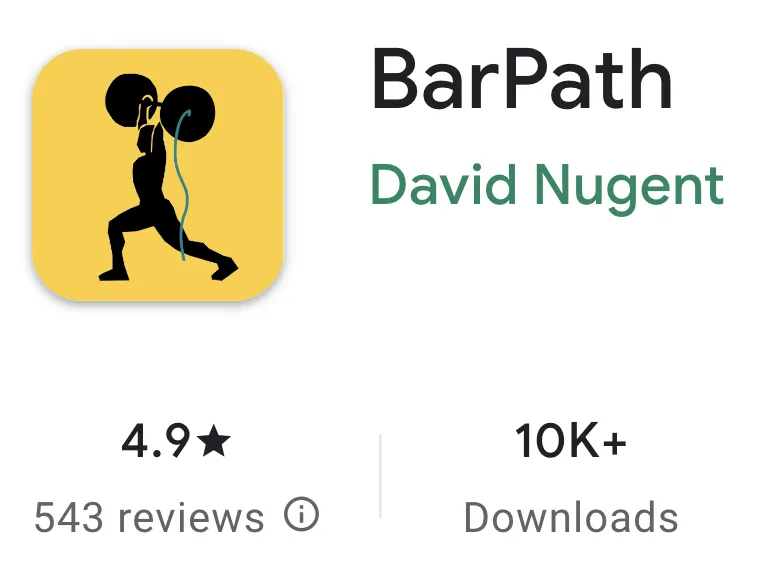
An app I made which used AI to track the path of a barbell during lifts. My first time training an AI model, in 2020
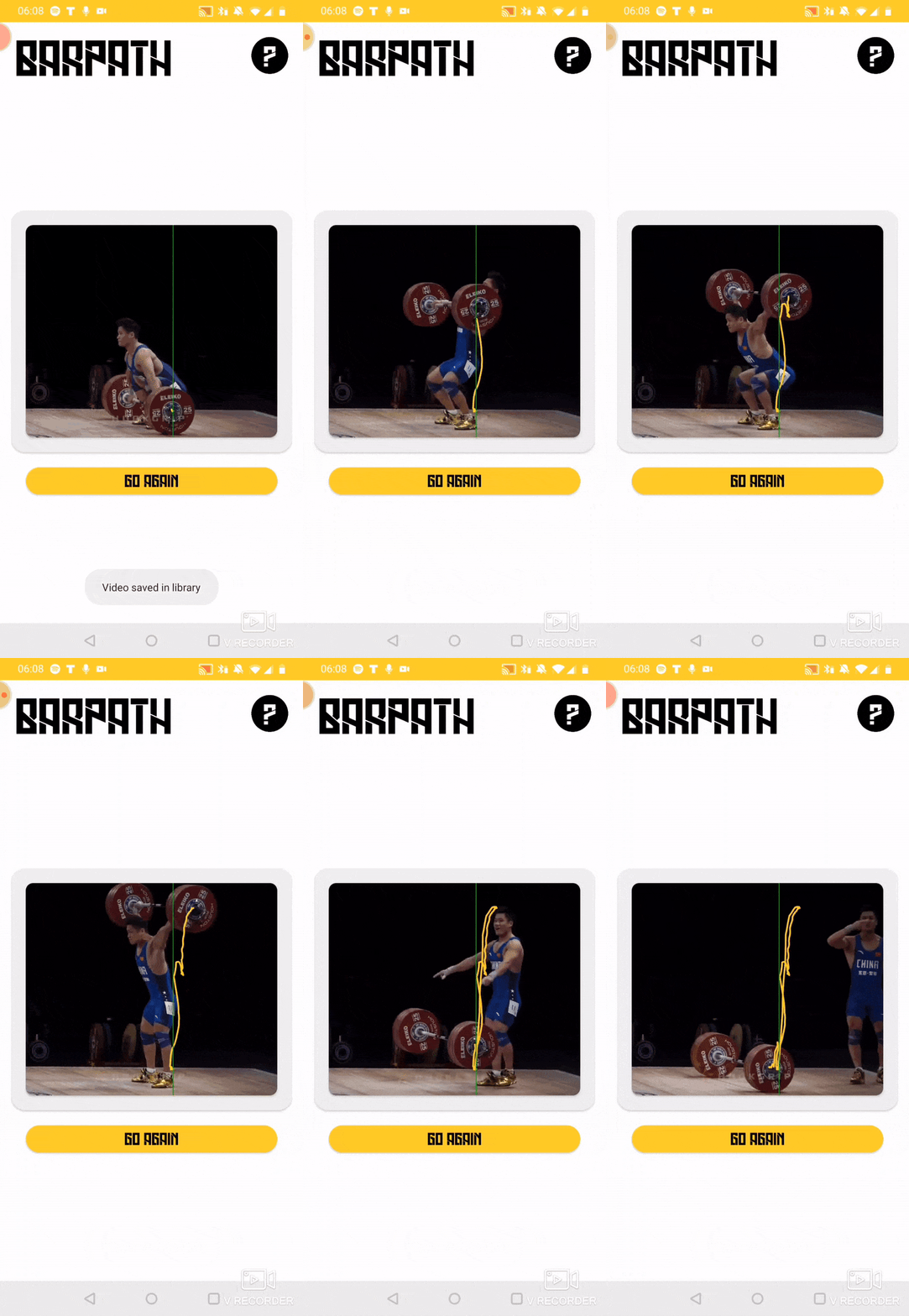
During the third year of my degree, I got involved with a new self-driving racecar team in Trinity, Formula Trinity Autonomous. Making new friends on this team got me through the remaining lockdowns. It was so much fun to work with like-minded people, while learning about autonomous vehicles. That year, I was the Perception Lead.
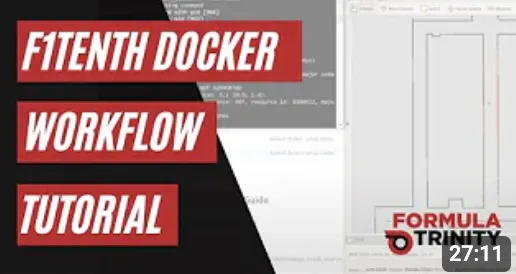
Some training I made for the new autonomous vehicles team I had joined: Formula Trinity Autonomous
The highlight of our year was running the AI Grand Prix, a virtual autonomous racing competition for college students. Installing robotics software was a big barrier to entry, so I developed a system which allowed competitors to write a simple Python script which took LiDAR data as input, and output a speed and steering angle, abstracting everything else away from them.
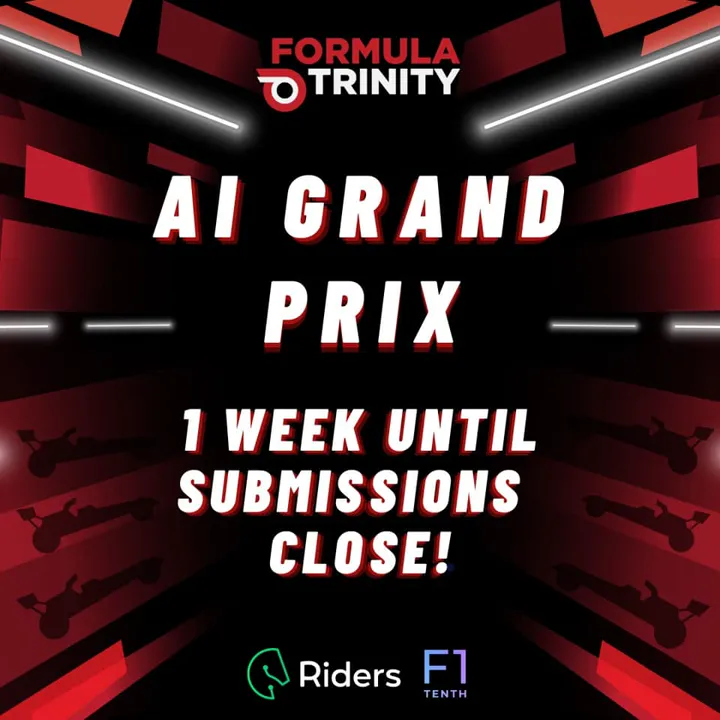
A virtual AI Grand Prix we hosted. I developed a submission method that allowed teams to control their racecars using a single Python script.
Meanwhile, to earn some money, I had been correcting Applied Maths exams for my old teacher, Oliver Murphy. When he decided to write his new textbook, he took me on board to write the teacher's solutions to the book's questions, and to provide suggestions about its contents.
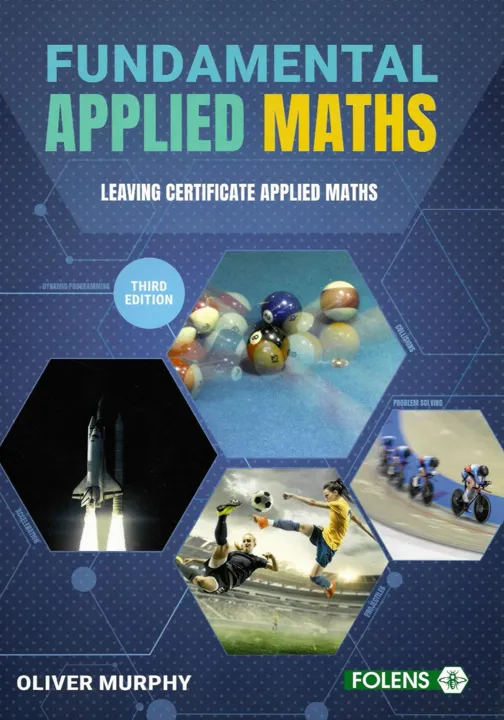
I wrote the teacher's solutions for the currently used Applied Maths book in Ireland
At the end of third year, I felt it was time for some industry experience, so I applied for an internship in Evervault, an early-stage cryptography startup in Dublin. Their interview process at that time involved choosing a project from their website. I didn't know what they were expecting, and I felt afraid of not impressing them enough, so I tried to get it done as soon as possible, to a high standard. The result was a Python implementation of the Raft consensus algorithm, written in less than two days.
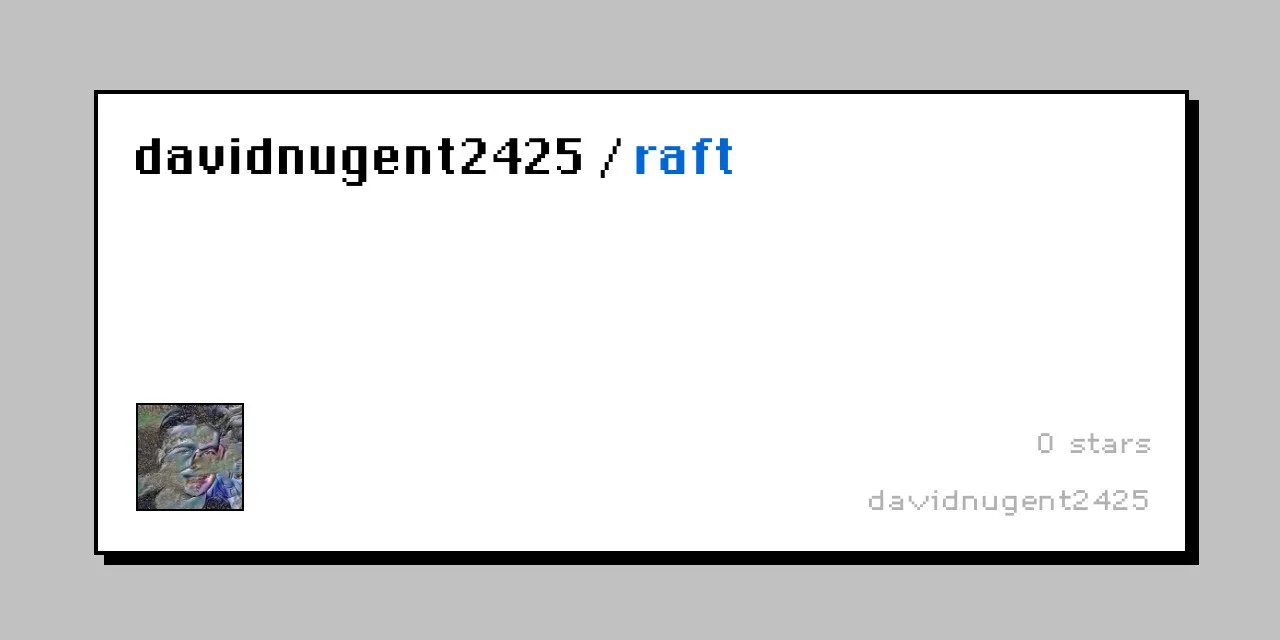
A Python implementation of the Raft concensus algorithm
That summer, as Evervault's sixth employee, I experienced the intensity, pressure, and excitement of an early stage startup. I also became proficient in Rust, which helped me to mature as a programmer.
The Evervault logo when I joined as an intern in their early days

The Rust programming language, my favourite for systems that need to work efficiently
Chapter 3: Leading
When I returned to college for my final year, the Autonomous team was finally working together in-person. This year, I got to lead the team with two of my best friends. I was tasked with leading the software engineering, which gave me the chance to take the skills I'd learned in Evervault, and use them in my own leadership style.
Our first competition was F1Tenth, in Prague, where we programmed an autonomous RC car to whir around the track autonomously. We were really proud about this, because we'd only received the vehicle six days before the competition.
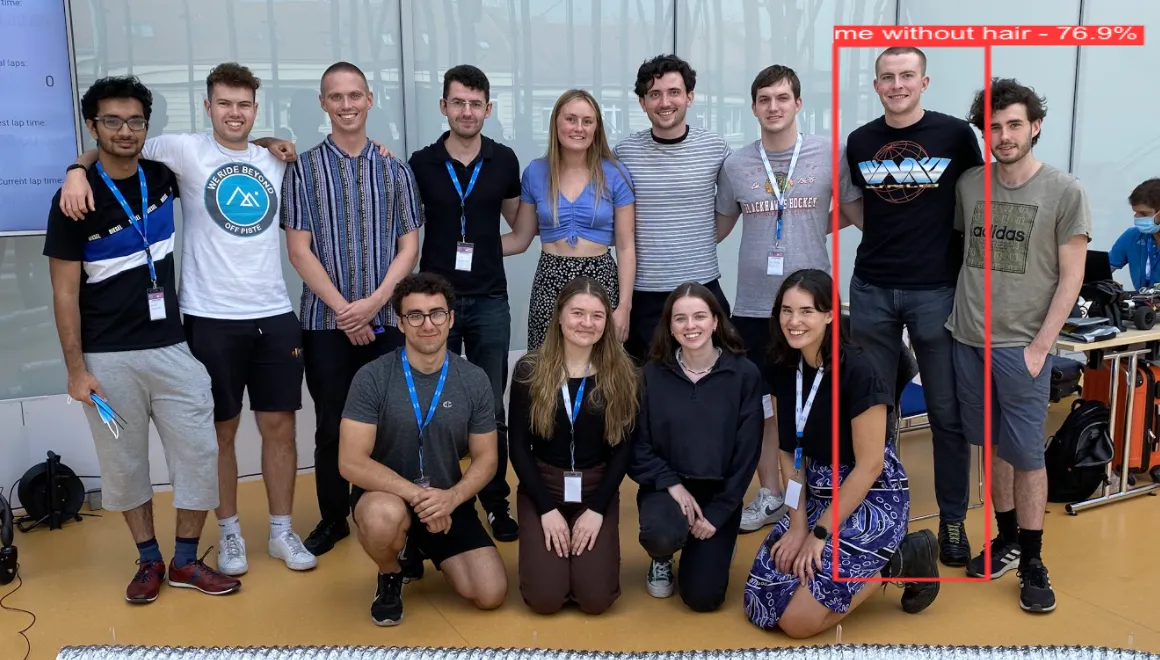
Competing in F1Tenth in Prague
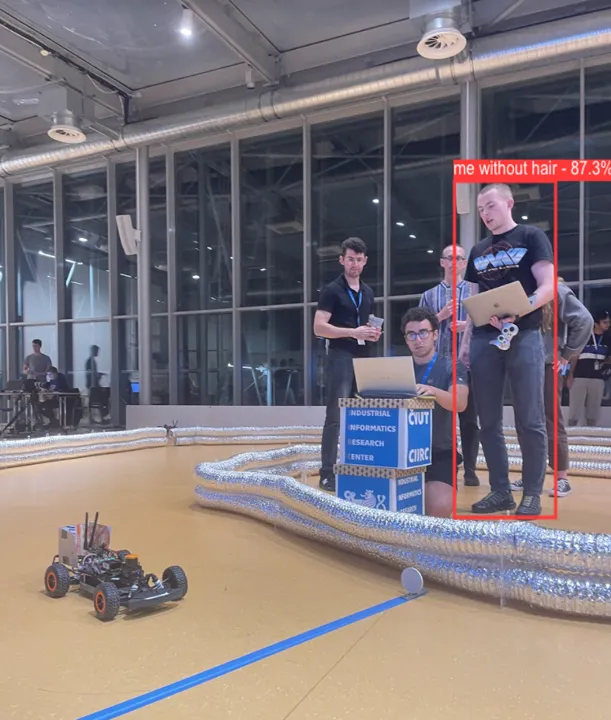

Our car racing around the track autonomously
A few months later, we competed at the Formula Student AI competition at the Silverstone Formula 1 racetrack. We won the Best Newcomer award, which we were chuffed with, because this competition had been the target of the Autonomous team since its inception.
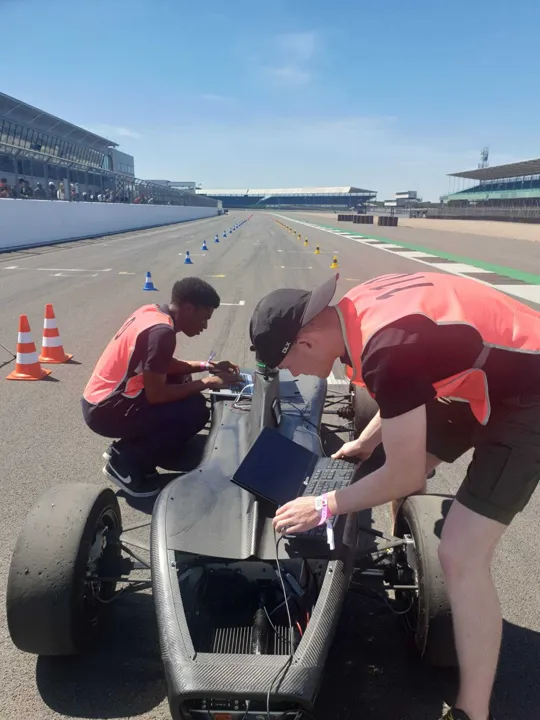
Competing in FS-AI at the Silverstone racetrack
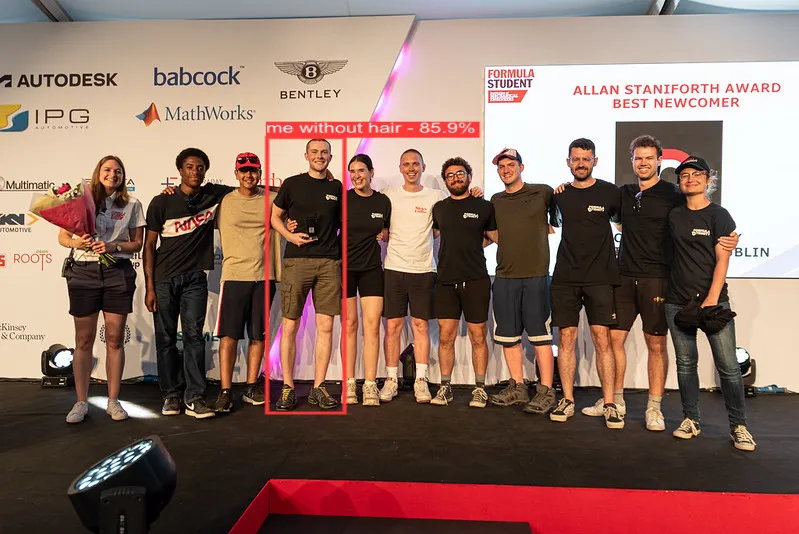
Winning the Best Newcomer award at FS-AI
For my undergrad thesis, I combined my interest in AI with my newfound cryptography interest, by proposing my own idea: using homomorphic encryption in credit card fraud detection AI models. It has a bunch of citations.
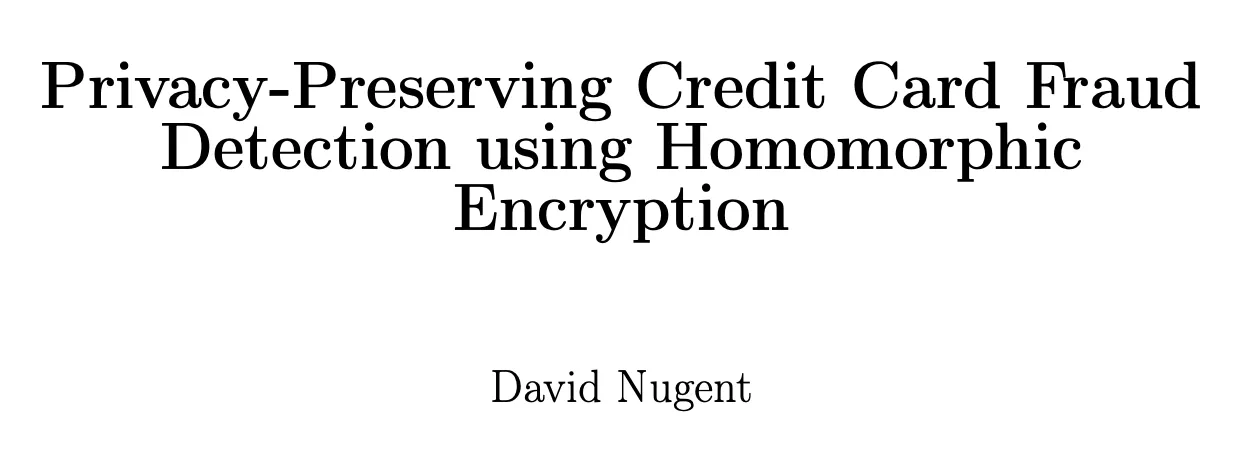
My undergraduate thesis, which combined my interests in AI and cryptography
Chapter 4: Professional
When I graduated with a First, I went back to Evervault for a year. I wanted to try out the forty-hour-a-week lifestyle of a career software engineer. I think Evervault was a great place to do that, because they have a combination of interesting, challenging, technical work along with the stability of venture capital funding. It also gave me the chance to sit beside and learn from excellent engineers.
By the time I returned to Evervault, they had a new logo
I began working on the Enclaves team, where we built Evervault's confidential computing solution. Once that product was launched, I got to lead a couple of projects myself: File Encryption and Optimizing the Encryption Engine. I had previously led teams in Formula Trinity, but this assured me that I could also do it in the 'real world'.
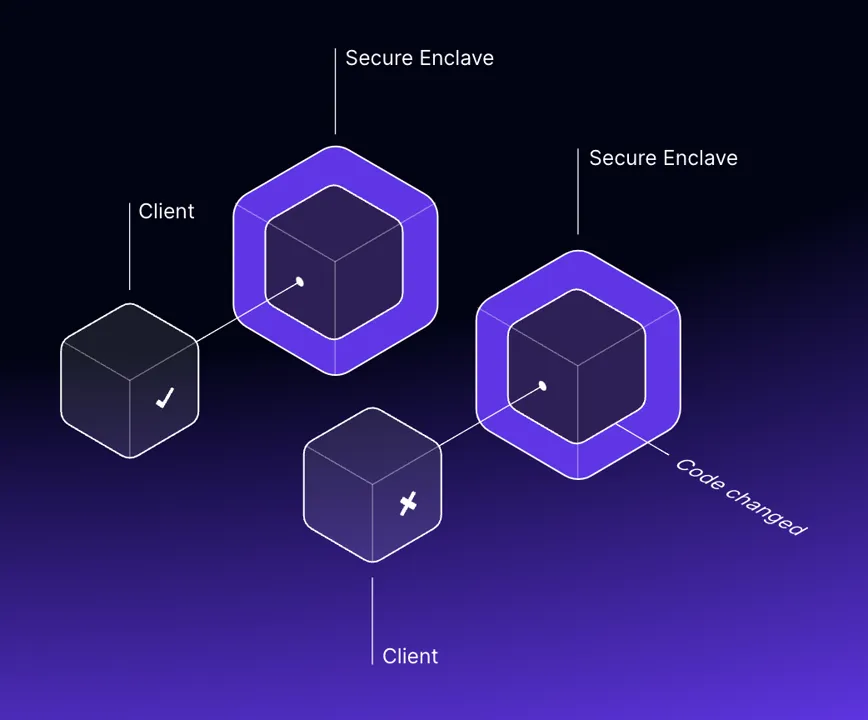
I worked on the Enclaves team when I came back
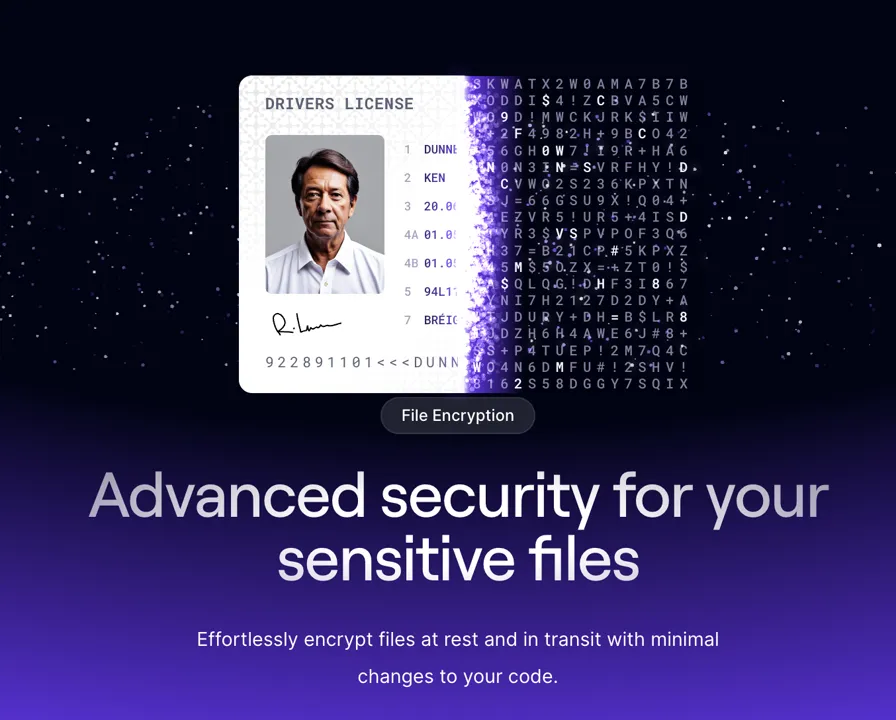
File Encryption, a project I led
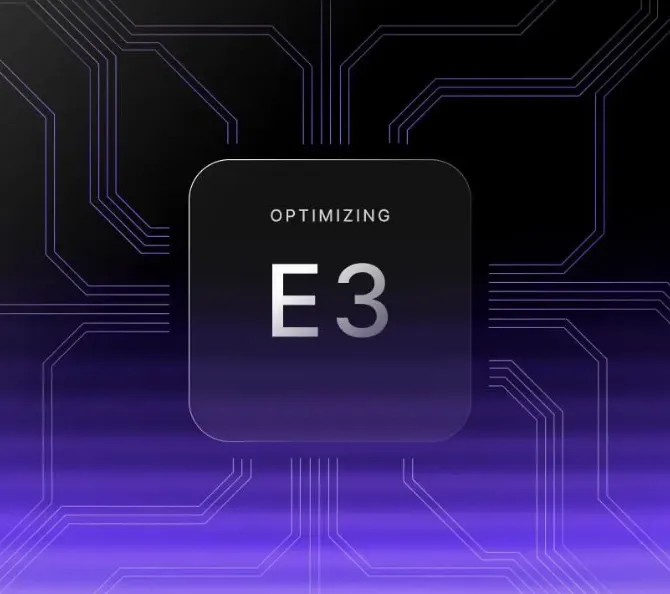
I optimized Evervault's encryption engine, and wrote this accompanying blog post
When working at the cutting edge, I often have ideas that I want to put in writing. Here are a few of the blog posts I made for Evervault about topics I found important or interesting.
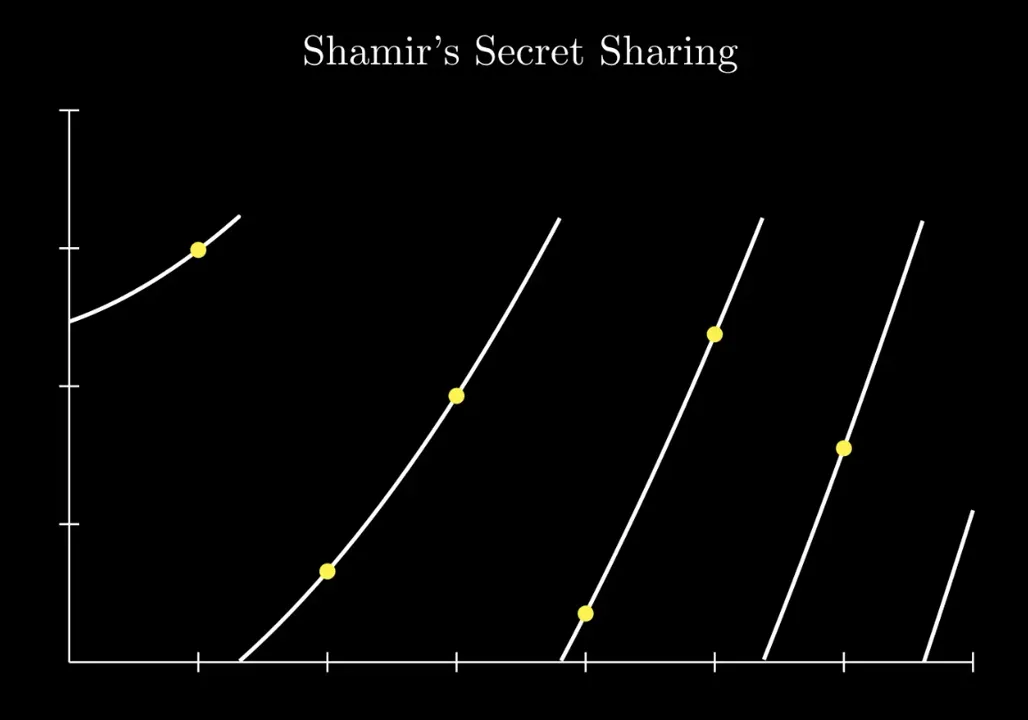
Shamir's Secret Sharing: Explanation and Visualization
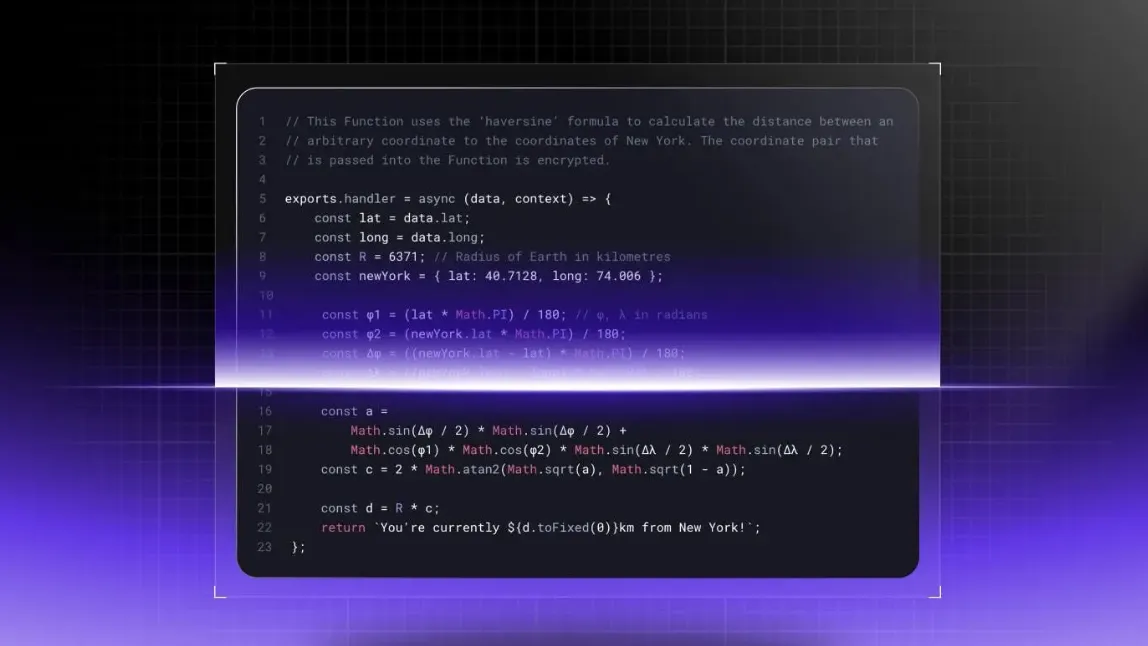
Code Attestation Needs to be Easier
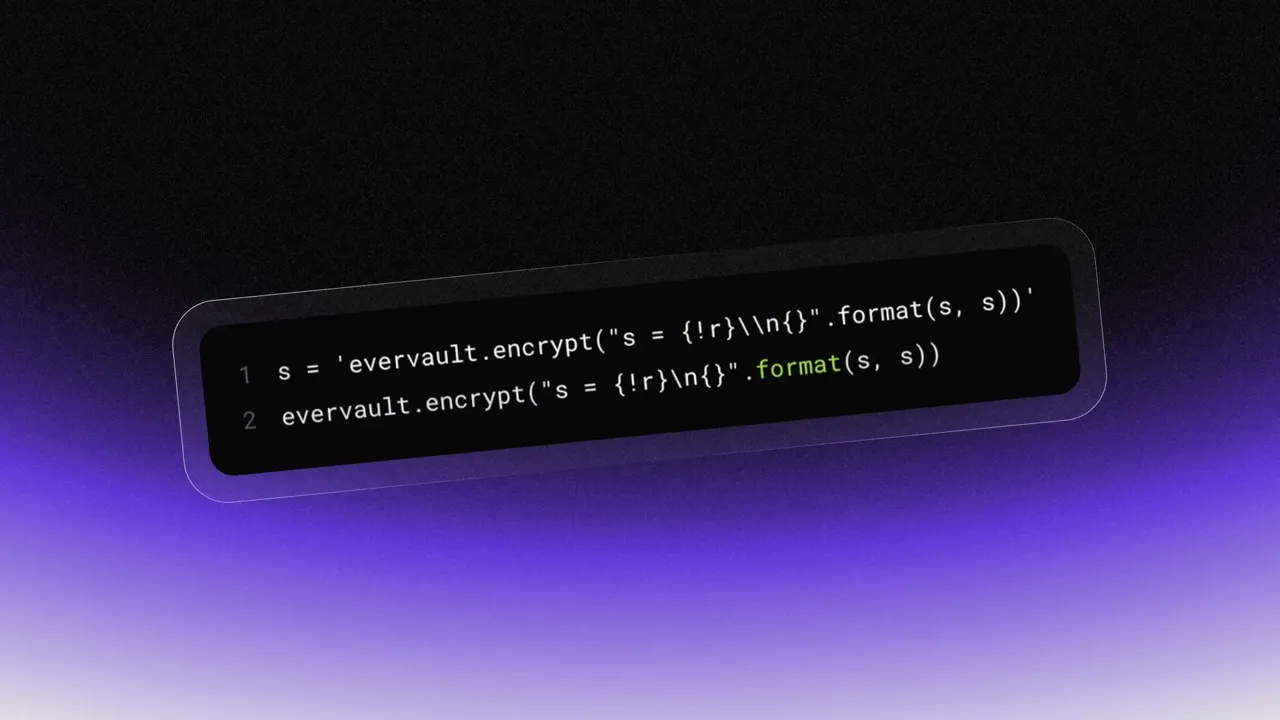
This Code Encrypts Itself
Chapter 5: Independent
I felt that I had ideas which I couldn't explore while I was working full-time for one company. AI was also causing the world of software engineering to be in constant flux, and I wanted to experiment with my own ways of working with it.
I decided to start freelancing. I think it was the right choice, as I was able to learn lots of new skills, express my creativity, and I was happier than before. For IP reasons, I can't discuss every project I did as a freelancer, but some of the skills I picked up included WebGL, WebAssembly, ThreeJS, Unity, Production LLM Usage and more. AI helped me to learn these new skills a lot quicker.
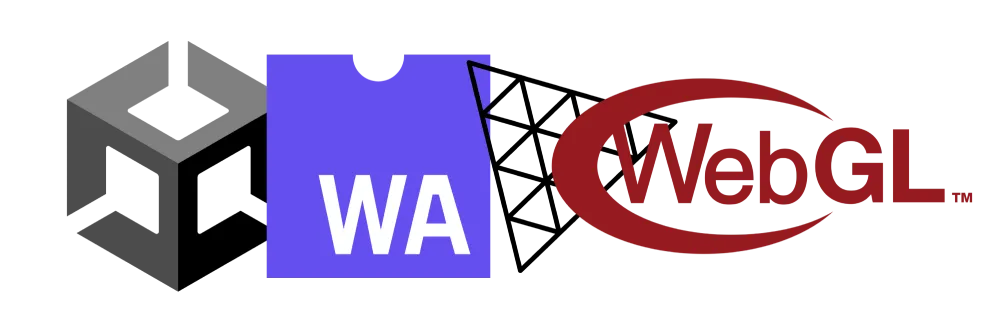
Some of the extra skills I've picked up since I started freelancing
I continued doing some technical writing for Evervault. This gave me a chance to play with my passion for education. I wrote some blog posts that combined text with other mediums, such as code, diagrams, and most importantly – mathematical visualizations.
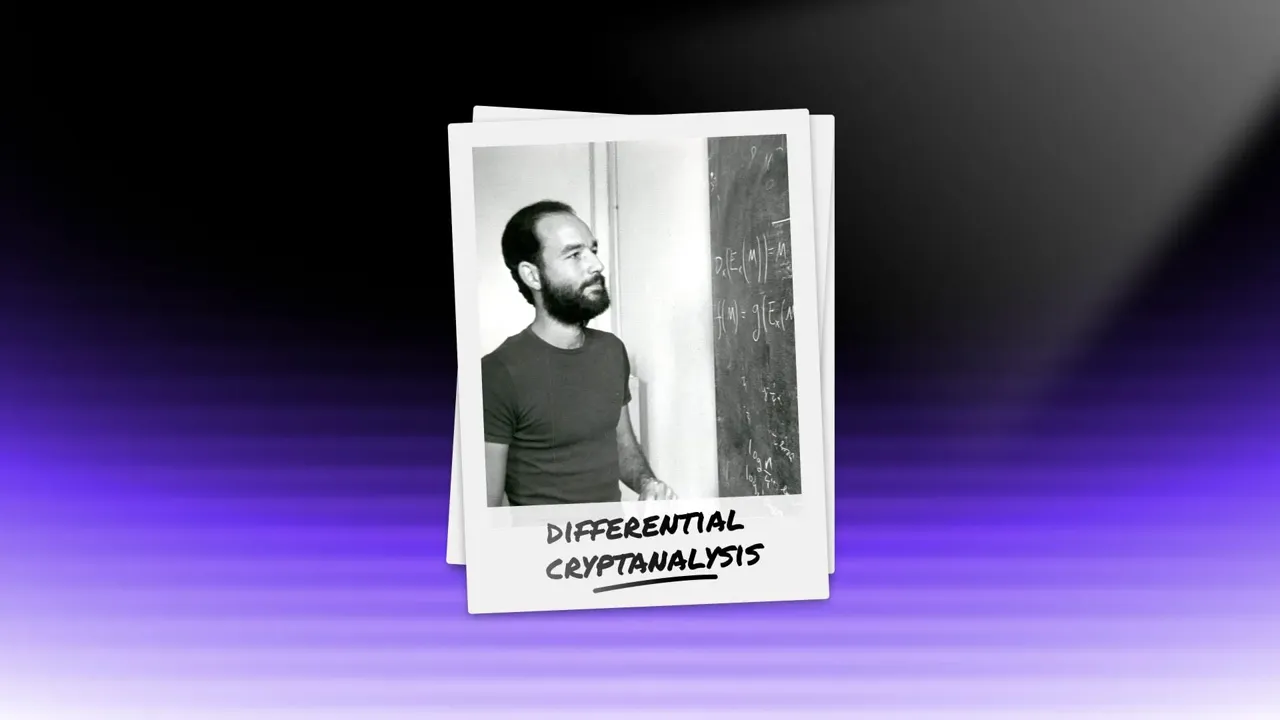
The Story and Math of Differential Cryptanalysis
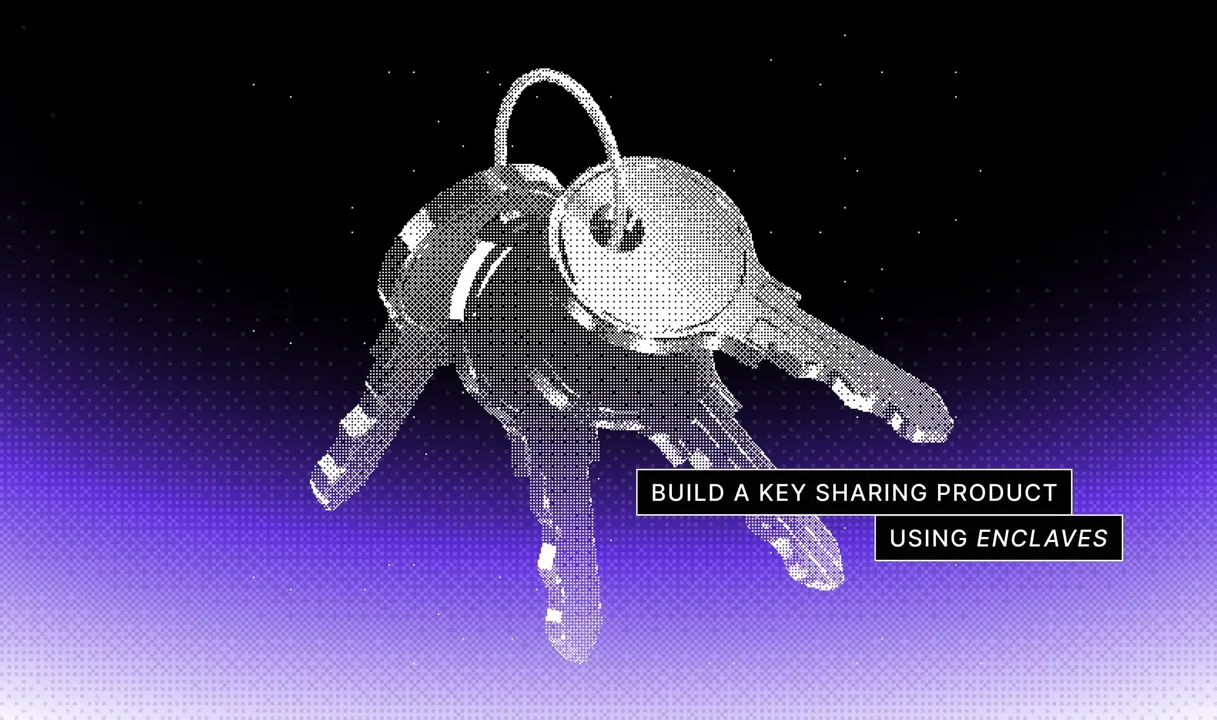
Building a Key Sharing Product Using Enclaves
I had made educational material before, but it was all based around autonomous vehicles.
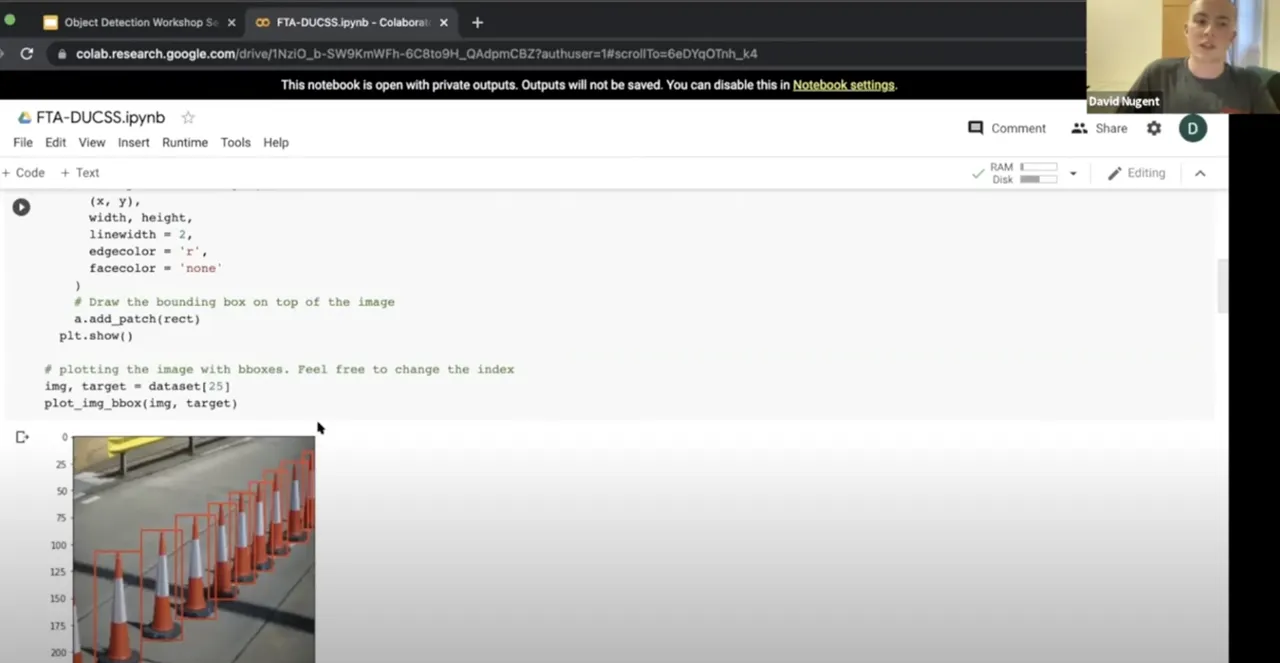
Object Detection Tutorial Using PyTorch
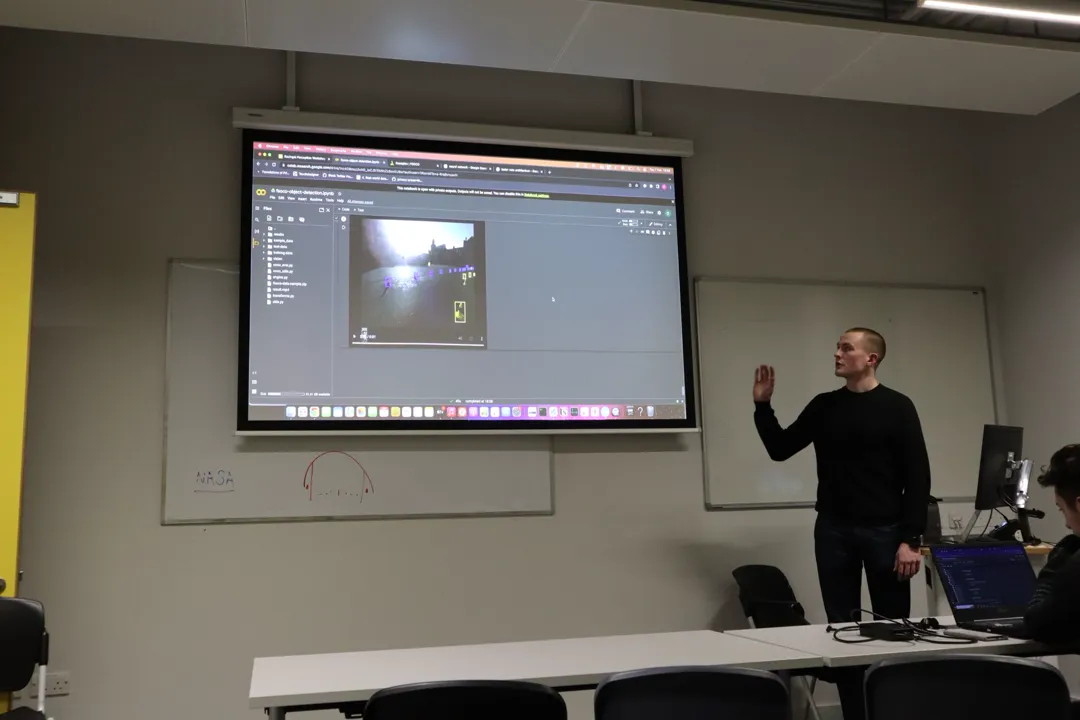
I created and held a series of workshops on autonomous vehicles for Irish universities
The maths visualizations I was doing in my new blog posts put me in contact with the founder of Retainit, a startup which was building games to help people retain important information. Retainit was the first client I worked with on a fixed-hour contract.

Retainit was the first client I worked with on a fixed-hour contract
An early collaborator with Retainit was 3Blue1Brown, the biggest maths YouTuber (6M+ subs), whose maths software I had used in my blog posts. We made games for his viewers which featured interactive maths components, to ensure that they got to exercise the tinkering parts of their brains. They were very well received!

One of the games I made for 3Blue1Brown fans, for Retainit
My work with Retainit spanned software engineering, project management, and R&D. One of the prototypes I made for them was an AI game show in which the AI host controls what happens in the webpage. This was one of the first demos of a voice agent controlling elements in a user's browser.
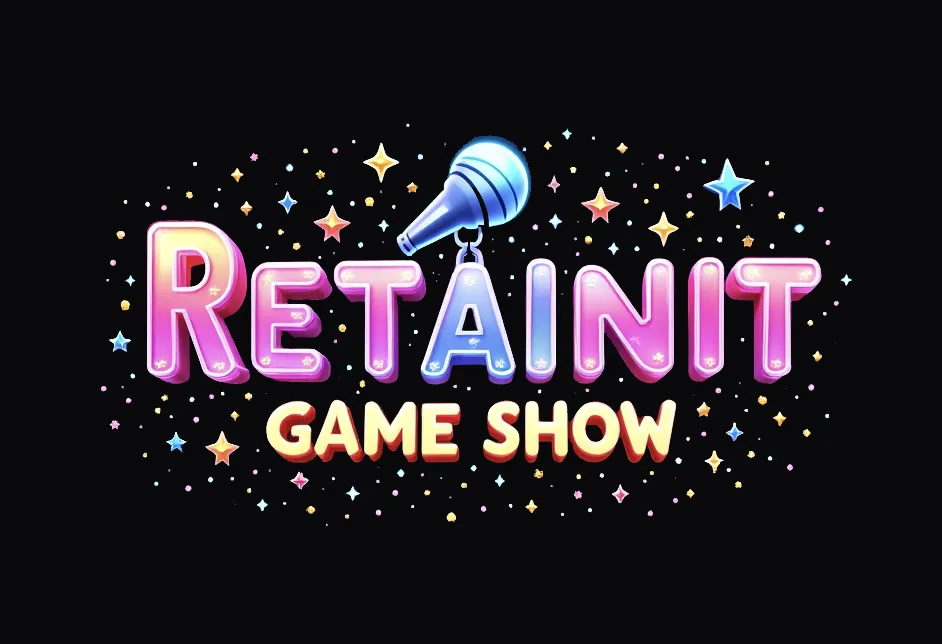
A game show hosted by a voice agent
The more I worked with companies, the more I felt that the best use of my skillset was in R&D. I enjoyed and excelled in ideation, prototyping, writing up proposals, and figuring out the best way to achieve something. I wanted to lean further into research in my next fixed-hour contract, so I decided to prepare myself by practicing R&D in my spare time. The first output of this was an article titled Is Homomorphic Encryption ready to solve the AI Privacy Problem?
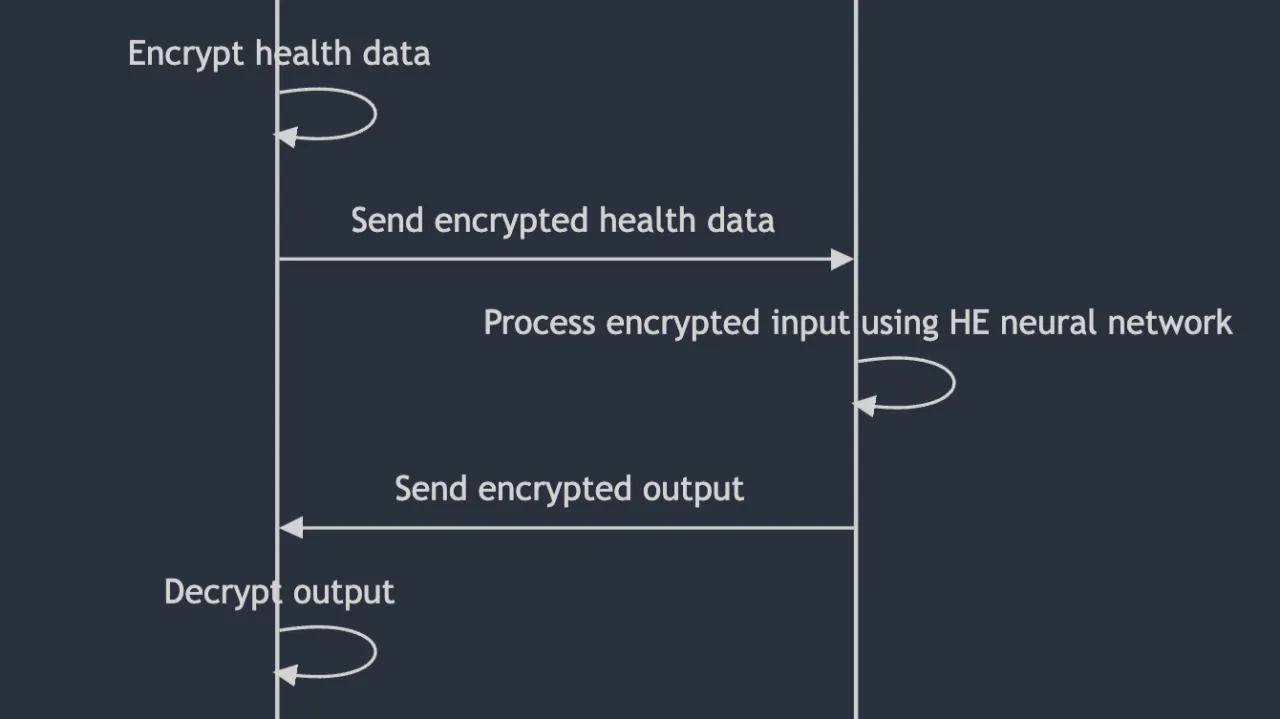
Is Homomorphic Encryption ready to solve the AI Privacy Problem?
One of the benefits of my flexible schedule was that I had time to mentor young people in technology, something I found very fulfilling.
I mentor in the Stem Passport for Inclusion programme, which addresses inequalities in access to STEM careers

I am a technical mentor in Patch, a free summer programme for talented young people
Chapter 6: Project Eleven
I heard about the threat posed by quantum computing to cryptography, and found post-quantum cryptography interesting. However, I still shrugged it off mostly as "quantum computers have only factored the number 15, right? So the attacks must still be decades off."
Then I was introduced to the founders of Project Eleven, a company that had been started a few weeks beforehand. They were focused on the quantum threat to digital assets. I took on some early contract work with them, which involved researching how broad and deep this threat really was. My mind was changed after that research, and I was convinced that this was a problem worth working on immediately.
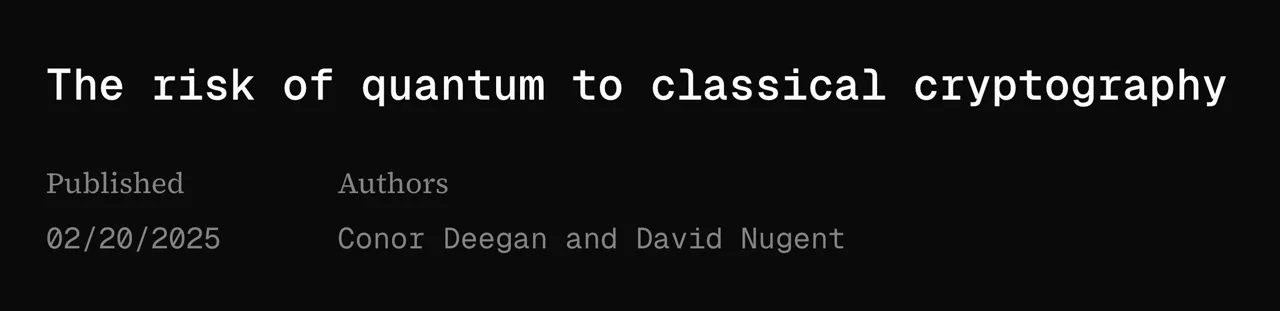
I co-wrote Project Eleven's initial analysis of the quantum threat, which confirmed to me that it was worth working on immediately
Focusing on cryptography again was a reminder of how well it aligned with my detail-oriented, sceptical, passionate personality, along with my computer science and mathematics skills. I decided I wanted to focus on cryptography and cybersecurity for the next several years. I figured Project Eleven would be a great place to do that, as the founders were highly competent, and great leaders.
I decided to work full time for Project Eleven as a Founding Engineer
During my time at Project Eleven, as a Founding Engineer in a small team, I worked on many areas including R&D, production-grade engineering, technical writing, project management, and leadership. My applied cryptography experience continued to deepen, including the low-level usage of cutting edge post-quantum schemes. We became known as the first experts in analysing and solving the quantum threat to digital assets, and our work was often cited by the most credible people in the blockchain ecosystem, e.g. Justin Drake of the Ethereum Foundation.
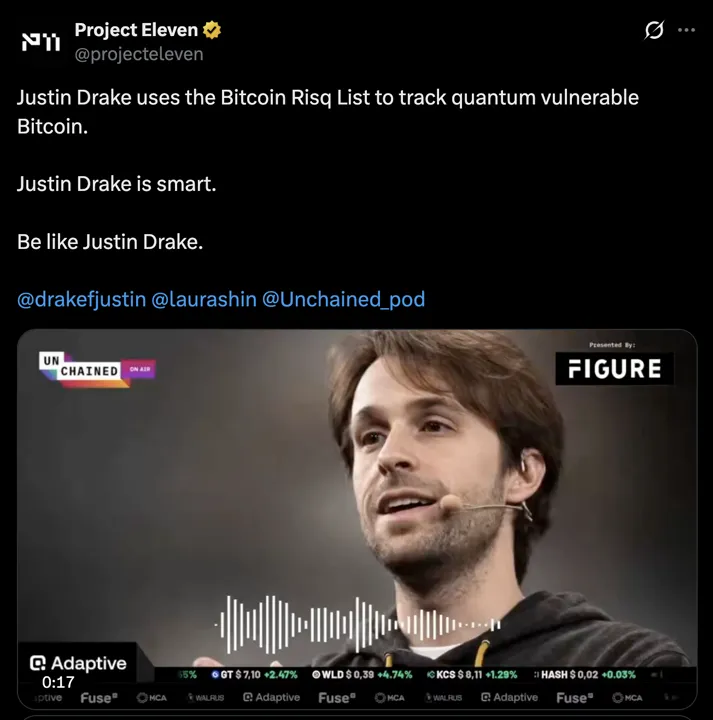
We became known as the first experts in analysing and solving the quantum threat to digital assets, and our work was often cited by the most credible people in the blockchain ecosystem, e.g. Justin Drake of the Ethereum Foundation
This expertise was also recognised by investors, which enabled us to raise a $6M seed round and a $20M Series A.
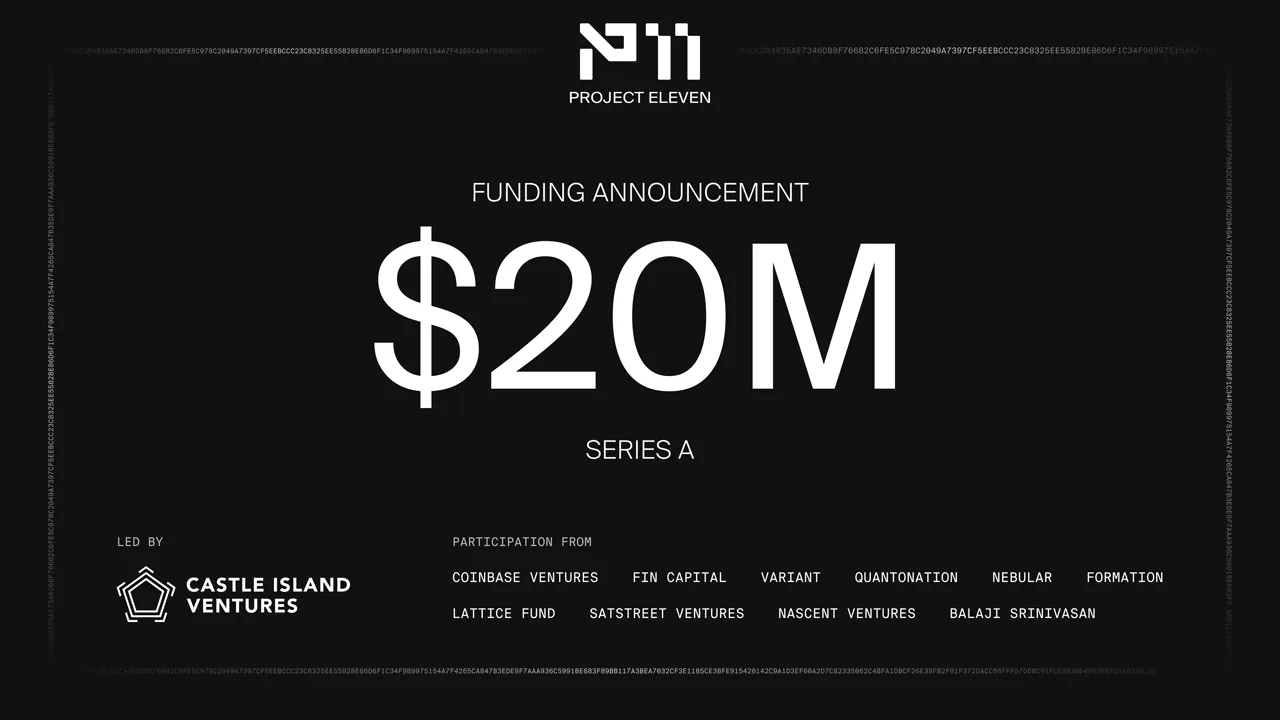
We raised a $6M seed round and a $20M Series A
Here are my favourite engineering projects that I was part of:
yellowpages: the first service for giving Bitcoin owners post-quantum proof of ownership. It worked by giving users post-quantum keypairs, and creating a TEE-proof that the owner of the Bitcoin wallet also owns these post-quantum keypairs. If their wallet is stolen by a quantum attacker someday, they would still have their post-quantum keypairs as evidence that they owned their Bitcoin wallet before Q-day happened.
My favourite technical achievements in yellowpages were:
- It performed an ML-KEM handshake over WebSockets to achieve post-quantum security in transit for all yellowpages users.
- It was one of the first production, audited uses of the NIST-standardized post-quantum signature schemes ML-DSA and SLH-DSA.
- It achieved state-of-the-art secure connections directly into AWS Nitro Enclaves TEEs from the browser, by using ML-KEM+AES-256 for encryption and providing a session attestation document during the ML-KEM handshake.
- It was the first service to provide people with post-quantum proofs of Bitcoin ownership, along with a whitepaper describing the ultimate vision for this idea.
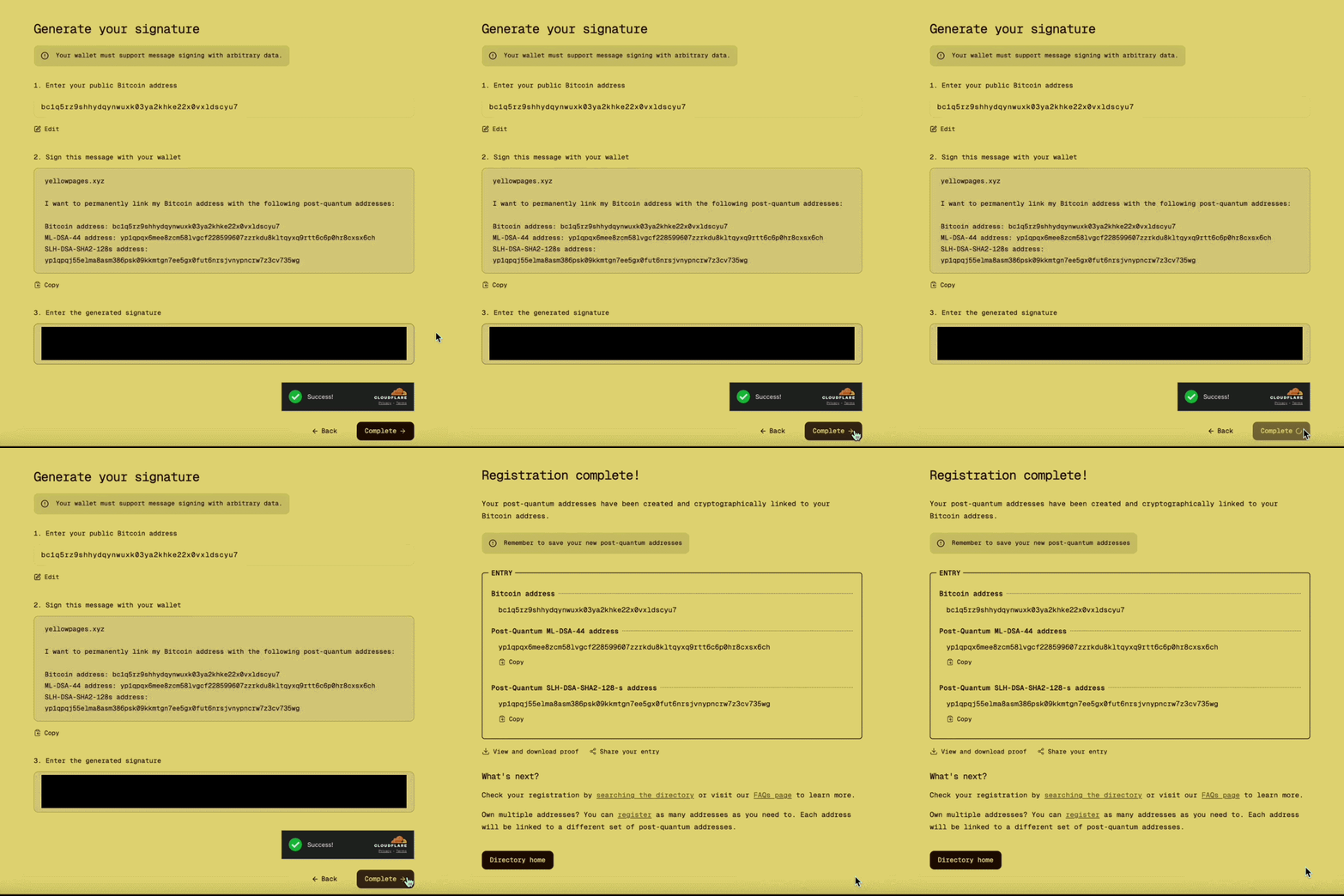
yellowpages was the first service for giving Bitcoin owners post-quantum proof of ownership, and included many technical achievements
Bitcoin Risq List: the first accurate, open-source, weekly analysis of the quantity of quantum-vulnerable Bitcoin. This became the go-to reference for the quantum risk to Bitcoin.
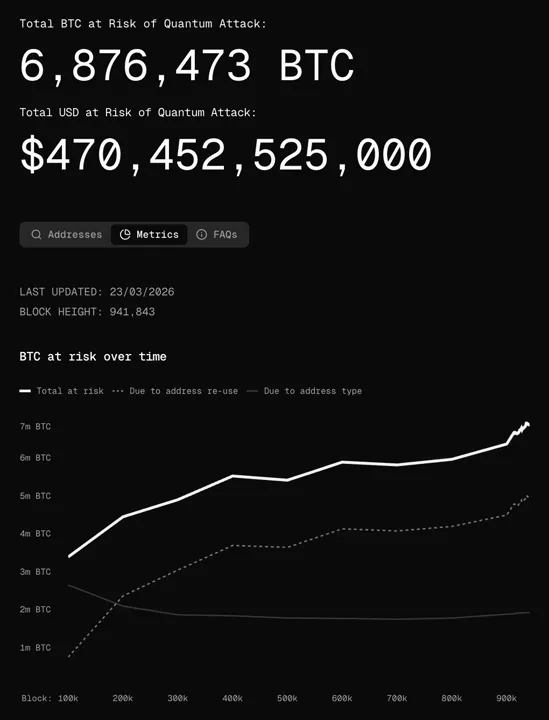
Bitcoin Risq List was the first accurate, open-source analysis of the quantity of quantum-vulnerable Bitcoin
howbigistoobig: an interactive 3D visualisation that compared the size and performance of post-quantum signature schemes to their classical predecessors.
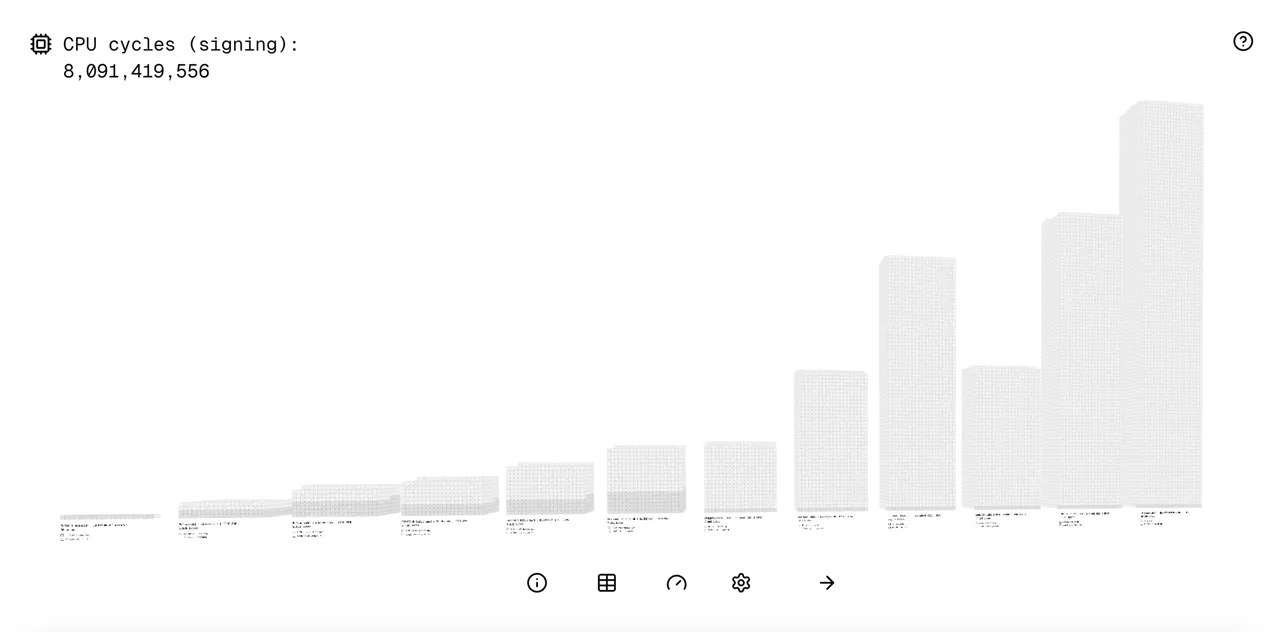
howbigistoobig was an interactive 3D visualisation that compared the size and performance of post-quantum signature schemes to their classical predecessors
Is My Browser Quantum Secure? An automatic check that ran when visiting the Project Eleven landing page, which detected if your browser supported post-quantum TLS.
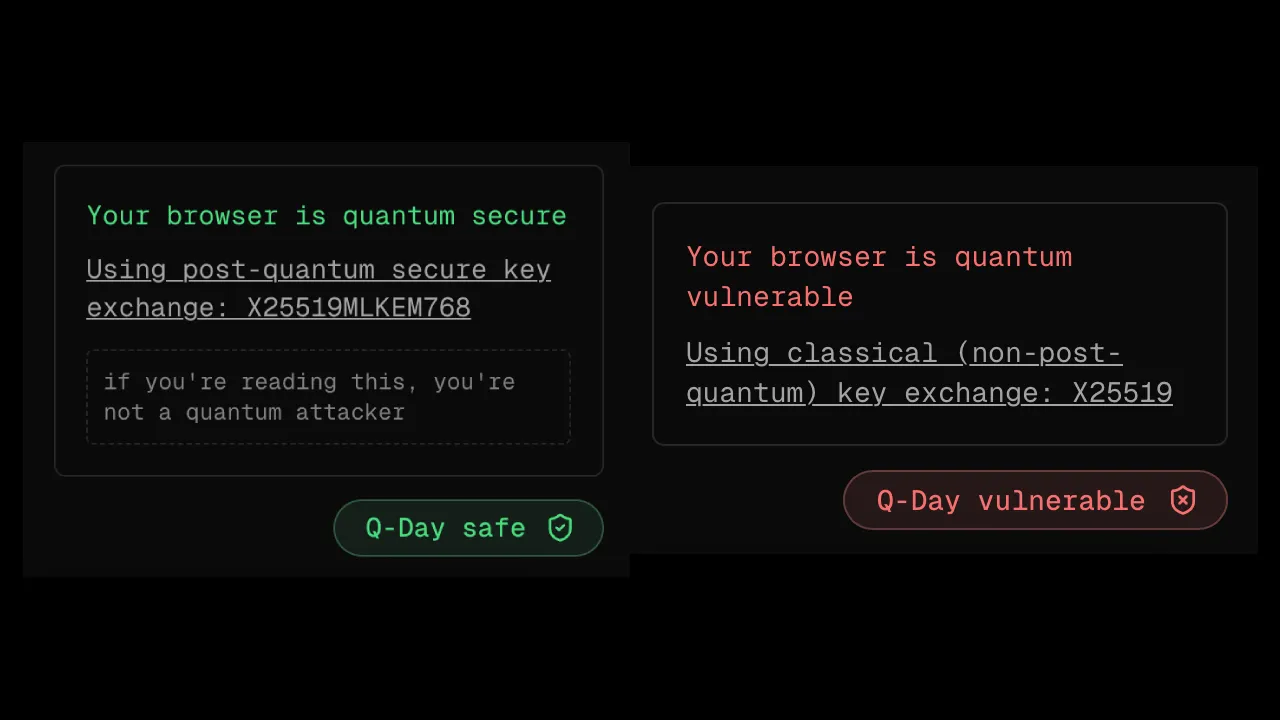
Is My Browser Quantum Secure? was an automatic check that ran when visiting the Project Eleven landing page, which detected if your browser supported post-quantum TLS
Stealth: I did a lot of cutting edge R&D for future Project Eleven products, but those haven't been released yet, so can't be discussed.
The quality of the Project Eleven blog was a demonstration of our technical skills, and a significant contribution to spreading awareness about the post-quantum threat to digital assets.
Here's a list of my favourite technical blog posts that I wrote or co-wrote:
- The risk of quantum to classical cryptography: Project Eleven's initial analysis of the quantum threat, which confirmed the hypothesis that it was worth working on immediately.
- The Trust Model of yellowpages v1: technical breakdown of the trust model of yellowpages, making all trust assumptions explicit. Trust models are often left for the user to figure out, and can be a grey area, but we wanted to be up-front about it for yellowpages.
- Guaranteeing post-quantum encryption in the browser: ML-KEM over WebSockets: technical breakdown of how yellowpages established a post-quantum encrypted channel using ML-KEM and AES between the user's browser and the TEE server.
- TEE Attestation from the Browser: technical breakdown of how yellowpages established an attested connection to the TEE server to establish trust before transmitting any sensitive data.
- The State of Post-Quantum Cryptography in Rust: The Belt is Vacant: an assessment of the landscape of post-quantum cryptography packages in Rust. This is likely outdated by now, but was highly relevant at the time.
- Surprises while verifying post-quantum signatures on a MacBook: a technical breakdown of findings while verifying ML-DSA signatures on a MacBook, which provided lessons for others who were designing post-quantum signature verification systems.
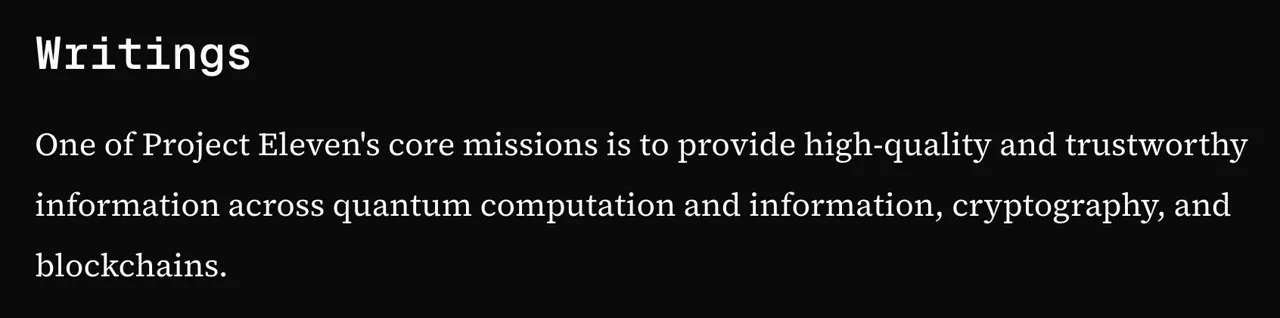
The quality of the Project Eleven blog was a demonstration of our technical skills, and a significant contribution to spreading awareness about the post-quantum threat to digital assets. Above this image, I've included a shortlist of my favourites
I had the opportunity to co-write a cryptography research paper, Lattice HD Wallets: Post-Quantum BIP32 Hierarchical Deterministic Wallets from Lattice Assumptions. This was the first post-quantum HD wallet construction that recovers BIP32's full public key derivation functionality with provable security under standard assumptions.
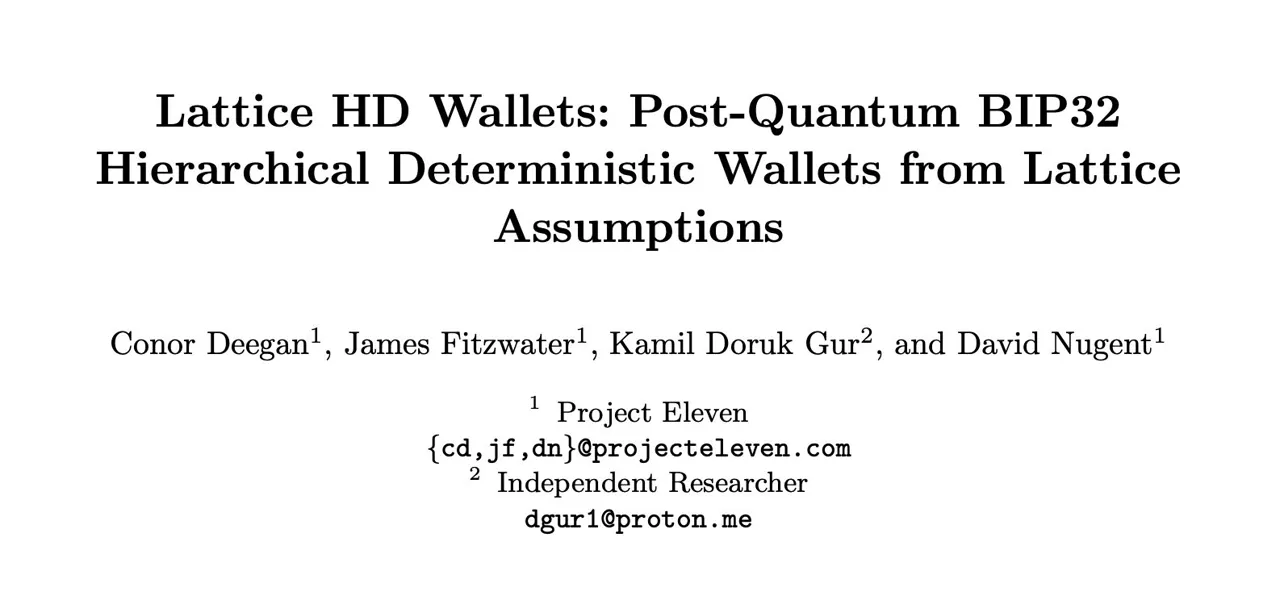
This was the first post-quantum HD wallet construction that recovers BIP32's full public key derivation functionality with provable security under standard assumptions
We did R&D work to advance post-quantum security for the Solana Network, in collaboration with the Solana Foundation. The reports we made were never released, so I can't go into detail on the work we did, but it was a great computer science milestone to work on the low-level cryptography of a high-performance blockchain.
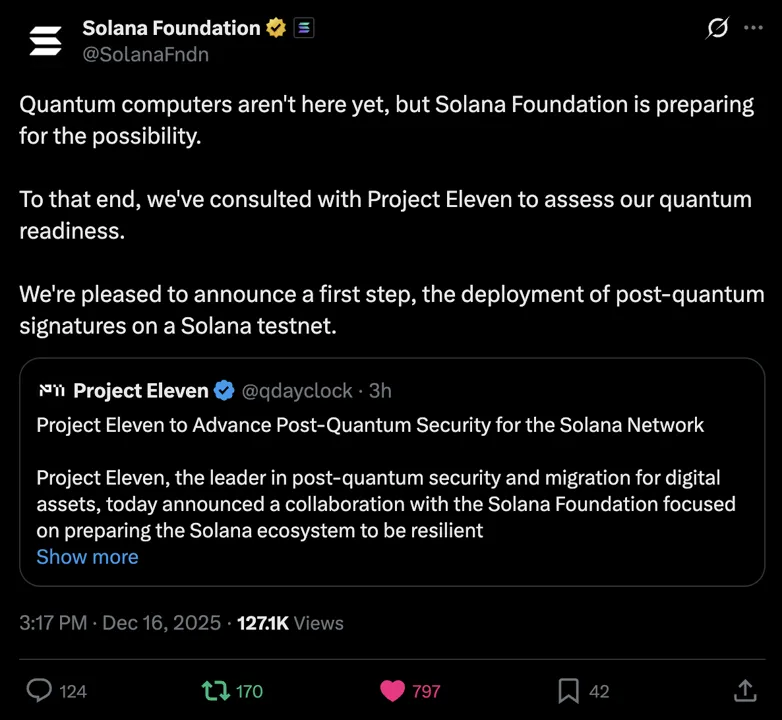
We did R&D work to advance post-quantum security for the Solana Network, in collaboration with the Solana Foundation
I learned how to build a technical brand for both the company and myself, through consistent meaningful technical posts on LinkedIn and X.
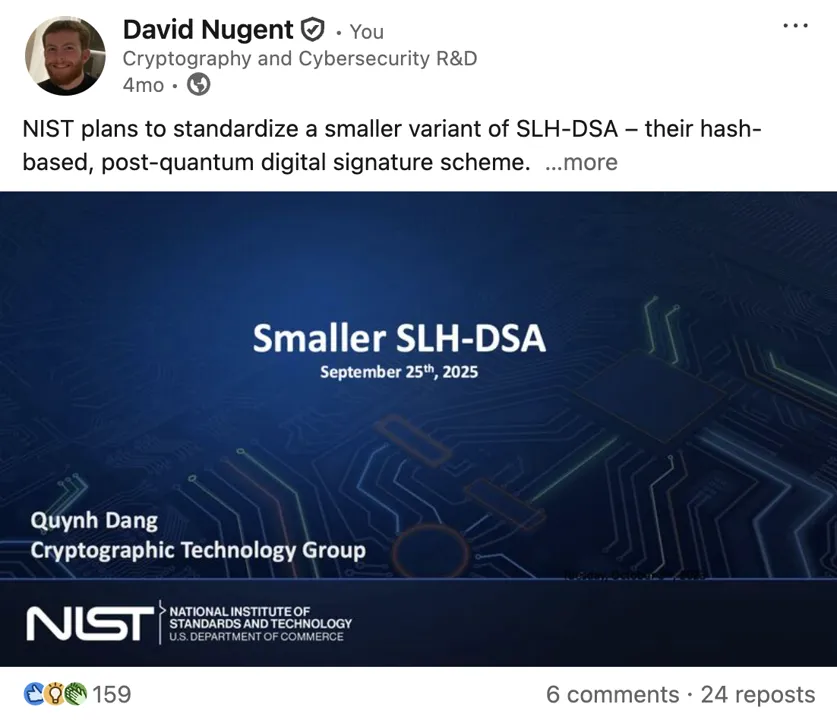
I learned how to build a technical brand for both the company and myself, through consistent meaningful technical posts on LinkedIn and X
Some of my favourite memories are of attending conferences with my Project Eleven colleagues, in which I got a chance to engage in technical discussions with experts at the cutting edge of both post-quantum cryptography and blockchain technology.
Real World Post-Quantum Cryptography Workshop
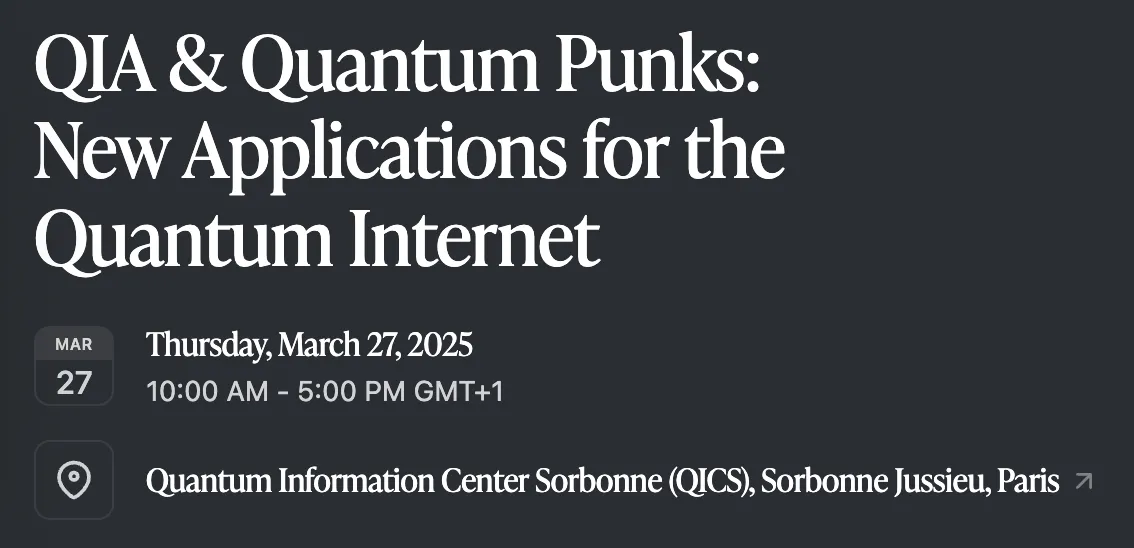
Quantum Punks Conference

Bitcoin Vegas Conference
Most importantly though, they were an opportunity to hang out with great teammates!
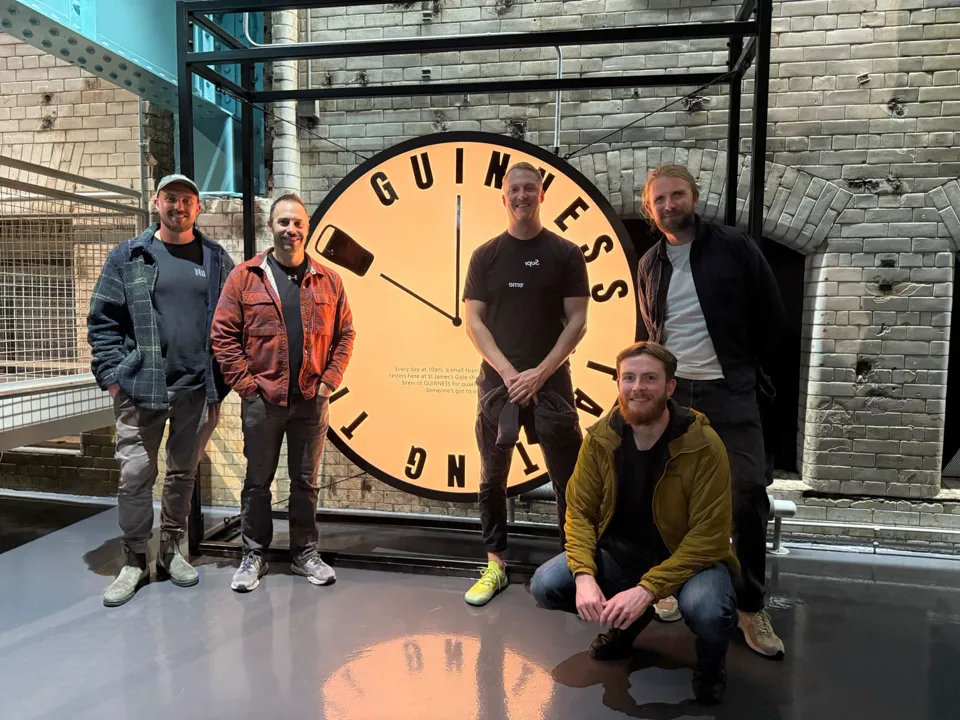
Times spent with teammates are always my favourite memories
Chapter 7: Breaks & Ciphers
I'm currently running Breaks & Ciphers, a small R&D lab focused on open-source cybersecurity, cryptography, and privacy.
These are the skills that I think have been most impactful in my career so far:
Cryptography
Cybersecurity
Software engineering
R&D
Problem solving
Critical thinking
Being fun to work with
Passion
Project management
Technical writing
Attention to detail
Thank you for visiting my portfolio. I haven't included my many hobbies, interests, and inspirations, because I don't want to broadcast them on the internet. However, I love chatting about them, so feel free to ask me!
Currently the best way to contact me is on LinkedIn or X: